TryHackMe: Advent Of Cyber 2025 Day 9 (Passwords - A Cracking Christmas)
Learn how to crack password-based encrypted files.
The Story

Introduction
With time between Easter and Christmas being destabilised, the once-quiet systems of The Best Festival Company began showing traces of encrypted data buried deep within their servers. Sir Carrotbane, stumbled upon a series of locked PDF and ZIP files labelled “North Pole Asset List.” Rumours spread that these could contain fragments of Santa’s master gift registry, critical information that could help Malhare control the festive balance between both worlds.
Sir Carrotbane sets out to crack the encryption, learning how weak passwords can expose even the most guarded secrets. Can the Elves adapt fast and prevent their secrets from being discovered?
How Attackers Recover Weak Passwords
Attackers don’t usually try to “break” the encryption itself because that would take far too long with modern cryptography. Instead, they focus on guessing the password that protects the file. The two most common ways of doing this are dictionary attacks and brute-force (or mask) attacks.
Dictionary Attacks
In a dictionary attack, the attacker uses a predefined list of potential passwords, known as a wordlist, and tests each one until the correct password is found. These wordlists often contain leaked passwords from previous breaches, common substitutions like password123, predictable combinations of names and dates, and other patterns that people frequently use. Because many users choose weak or common passwords, dictionary attacks are usually fast and highly effective.
Mask Attacks
Brute-force and mask attacks go one step further. A brute-force attack systematically tries every possible combination of characters until it finds the right one. While this guarantees success eventually, the time it takes grows exponentially with the length and complexity of the password.
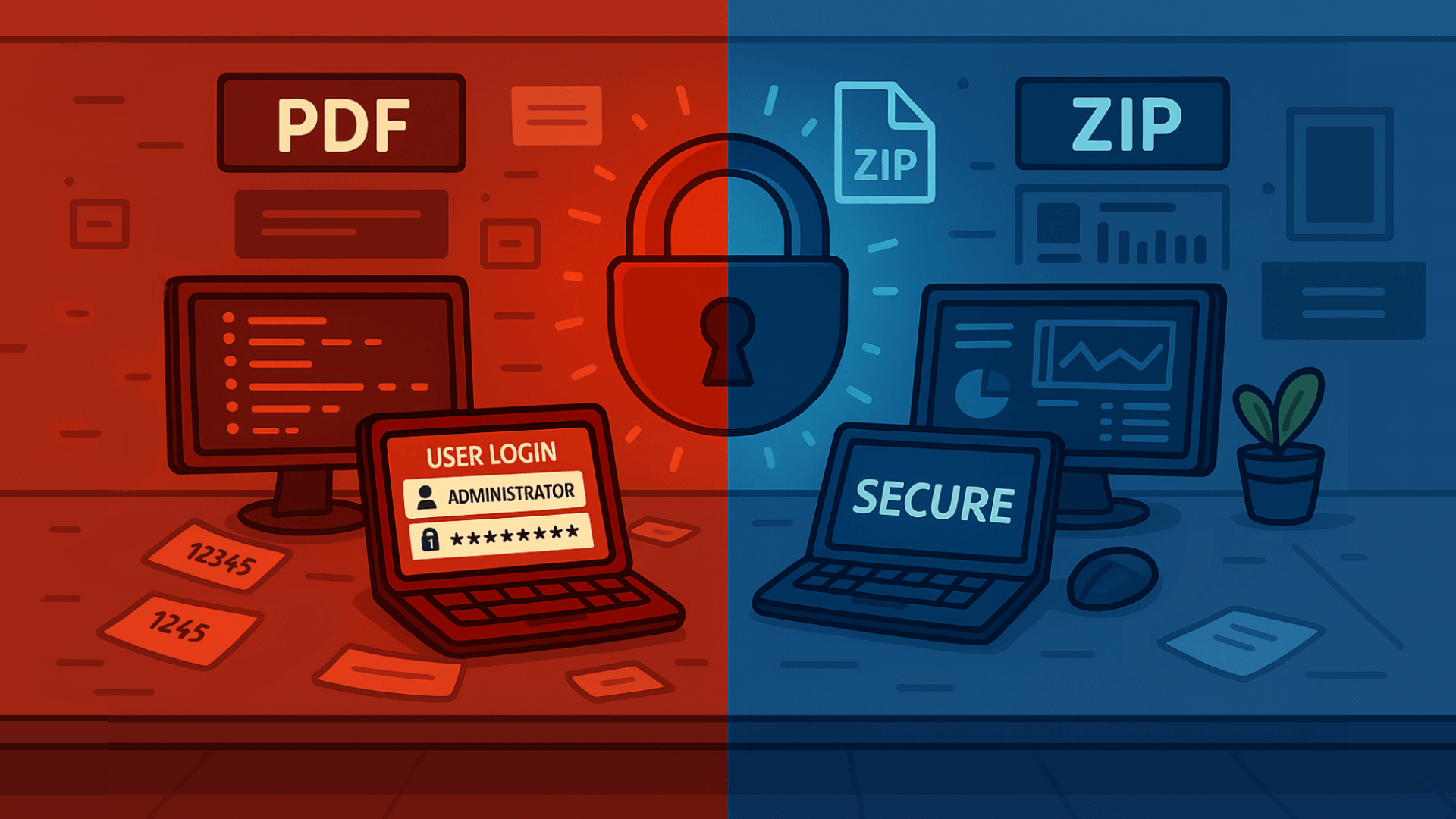
Mask attacks aim to reduce that time by limiting guesses to a specific format. For example, trying all combinations of three lowercase letters followed by two digits.
By narrowing the search space, mask attacks strike a balance between speed and thoroughness, especially when the attacker has some idea of how the password might be structured.
Practical tips attackers use (and defenders should know about):
- Start with a wordlist (fast wins). Common lists:
rockyou.txt,common-passwords.txt. - If the wordlist fails, move to targeted wordlists (company names, project names, or data from the target).
- If that fails, try mask or incremental attacks on short passwords (e.g.
?l?l?l?d?d= three lowercase letters + two digits, which is used as a password mask format by password cracking tools). - Use GPU-accelerated cracking when possible; it dramatically speeds up attacks for some algorithms.
- Keep an eye on resource use: cracking is CPU/GPU intensive. That behaviour can be detected on a monitored endpoint.
Exercise
You will find the files for this section in the Desktop directory of the machine. Switch to it by running cd Desktop in your terminal.
1. Confirm the File Type
Use the file command or open the file with a hex viewer. This helps pick the right tool.
1
2
ubuntu@tryhackme:~/Desktop$ file flag.pdf
ubuntu@tryhackme:~/Desktop$ file flag.zip
If it’s a PDF, proceed with PDF tools. If it’s a ZIP, proceed with ZIP tools.
2. Tools to Use (pick one based on file type)
- PDF:
pdfcrack,john(via pdf2john) - ZIP:
fcrackzip,john(via zip2john) - General:
john(very flexible) andhashcat(GPU acceleration, more advanced)
3. Try a Dictionary Attack First (fast, often successful)
Example: PDF with pdfcrack and rockyou.txt:
1
2
3
4
5
6
7
8
9
10
11
12
13
14
15
16
17
18
19
20
ubuntu@tryhackme:~/Desktop$ pdfcrack -f flag.pdf -w /usr/share/wordlists/rockyou.txt
PDF version 1.7
Security Handler: Standard
V: 2
R: 3
P: -1060
Length: 128
Encrypted Metadata: True
FileID: 3792b9a3671ef54bbfef57c6fe61ce5d
U: c46529c06b0ee2bab7338e9448d37c3200000000000000000000000000000000
O: 95d0ad7c11b1e7b3804b18a082dda96b4670584d0044ded849950243a8a367ff
Average Speed: 29538.5 w/s. Current Word: 's8t8a8r8'
Average Speed: 31068.0 w/s. Current Word: 'toby344'
Average Speed: 30443.7 w/s. Current Word: 'erikowa'
Average Speed: 29519.3 w/s. Current Word: '0848845800'
Average Speed: 29676.4 w/s. Current Word: 'u3904041'
Average Speed: 29339.8 w/s. Current Word: 'spider0187'
Average Speed: 30156.8 w/s. Current Word: 'roermond7'
Average Speed: 30364.8 w/s. Current Word: 'papaopass2'
found user-password: 'XXXXXXXXXX'
Detection of Indicators and Telemetry
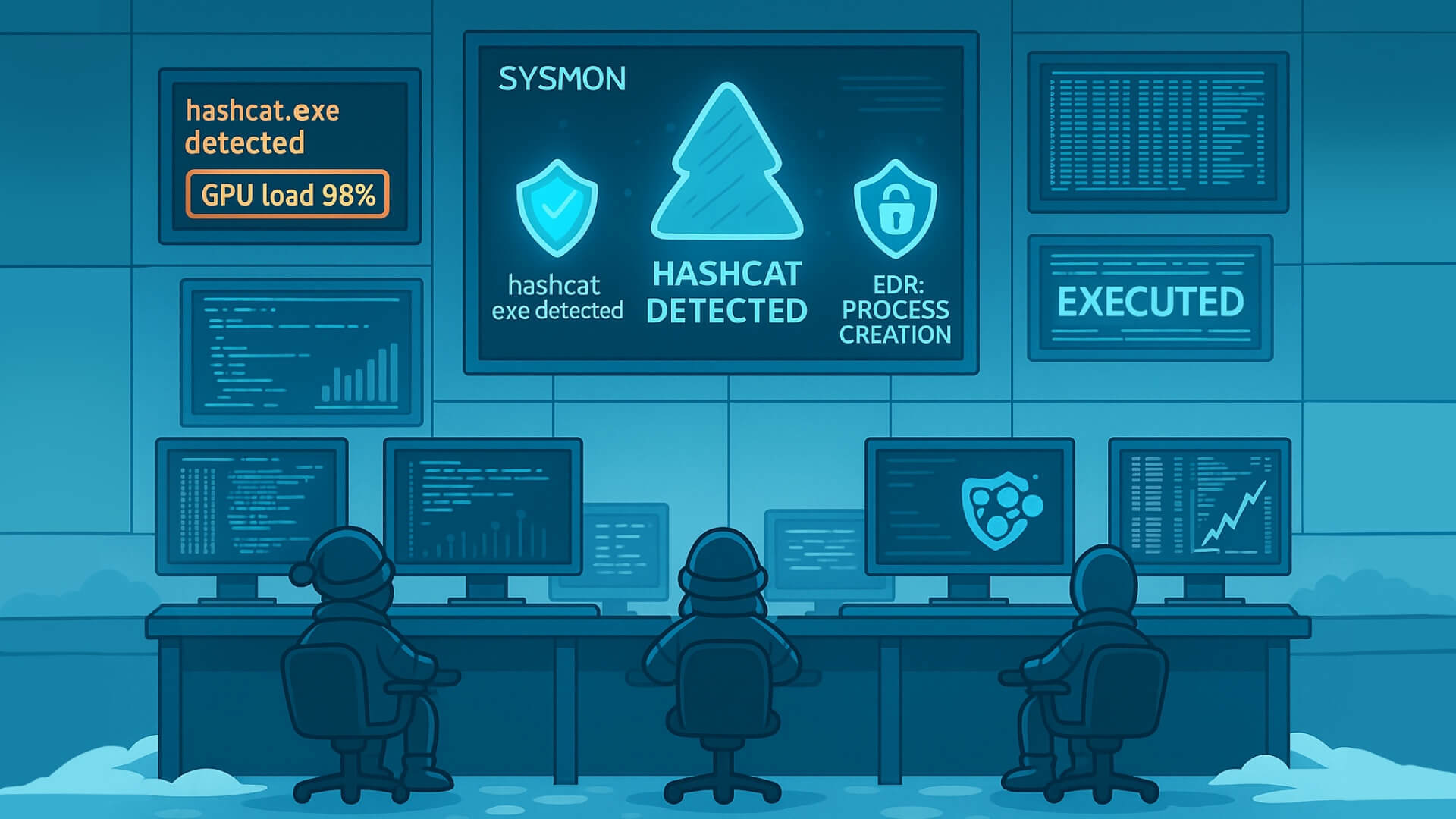
Offline cracking does not hit login services, so lockouts and failed logon dashboards stay quiet. We can detect the work where it runs, on endpoints and jump boxes. The important signals to monitor include:
Process creation: Password cracking has a small set of well-known binaries and command patterns that we can look out for. A mix of process events, file activity, GPU signals, and network touches tied to tooling and wordlists. Our goal is to make the activity obvious without drowning in noise.
- Binaries and aliases:
john,hashcat,fcrackzip,pdfcrack,zip2john,pdf2john.pl,7z,qpdf,unzip,7za,perlinvokingpdf2john.pl. - Command‑line traits:
--wordlist,-w,--rules,--mask,-a 3,-min Hashcat, references torockyou.txt,SecLists,zip2john,pdf2john. - Potfiles and state:
~/.john/john.pot,.hashcat/hashcat.potfile,john.rec.
It’s worth noting that on Windows systems, Sysmon Event ID 1 captures process creation with full command line properties, while on Linux, auditd, execve, or EDR sensors capture binaries and arguments.
GPU and Resource Artefacts
GPU cracking is loud. Sudden high utilisation on hosts can be picked up and would need to be investigated.
nvidia-smishows long-running processes namedhashcatorjohn.- High, steady GPU utilization and power draw while the fan speed spikes.
- Libraries loaded include:
nvcuda.dll,OpenCL.dll,libcuda.so,amdocl64.dll.
Network Hints, Light but Useful
Offline cracking does not need the network once wordlists are present. Yet most operators fetch lists and tools first.
- Downloads of large text files such as
rockyou.txt, or Git clones of common wordlist repositories. - Package installations (e.g.,
apt install john hashcat) detected through EDR or package telemetry. - Tool updates and driver downloads for GPU runtimes.
Unusual File Reads
Repeated reads of files such as wordlists or encrypted files would need analysis.
Detections
Below are some examples of detection rules and hunting queries we can put to use across various environments.
Sysmon:
1
2
3
4
(ProcessName="C:\Program Files\john\john.exe" OR
 ProcessName="C:\Tools\hashcat\hashcat.exe" OR
 CommandLine="*pdf2john.pl*" OR
 CommandLine="*zip2john*")
Linux audit rules, temporary for an investigation:
1
2
3
auditctl -w /usr/share/wordlists/rockyou.txt -p r -k wordlists_read
auditctl -a always,exit -F arch=b64 -S execve -F exe=/usr/bin/john -k crack_exec
auditctl -a always,exit -F arch=b64 -S execve -F exe=/usr/bin/hashcat -k crack_exec
Sigma style rule, Windows process create for cracking tools:
1
2
3
4
5
6
7
8
9
10
11
12
13
14
15
16
17
18
19
20
21
22
23
24
25
title: Password Cracking Tools Execution
id: 9f2f4d3e-4c16-4b0a-bb3a-7b1c6c001234
status: experimental
logsource:
  product: windows
  category: process_creation
detection:
  selection_name:
    Image|endswith:
      - '\john.exe'
      - '\hashcat.exe'
      - '\fcrackzip.exe'
      - '\pdfcrack.exe'
      - '\7z.exe'
      - '\qpdf.exe'
  selection_cmd:
    CommandLine|contains:
      - '--wordlist'
      - 'rockyou.txt'
      - 'zip2john'
      - 'pdf2john'
      - '--mask'
      - ' -a 3'
  condition: selection_name or selection_cmd
level: medium
Response Playbook
As security analysts in Wareville, it is important to have a playbook to follow when such incidents occur. The immediate actions to take are:
- Isolate the host if malicious activity is detected. If it is a lab, tag and suppress.
- Capture triage artefacts such as process list, process memory dump,
nvidia-smisample output, open files, and the encrypted file. - Preserve the working directory, wordlists, hash files, and shell history.
- Review which files were decrypted. Search for follow‑on access, lateral movement or exfiltration.
- Identify the origin and intent of the activity. Was this authorised? If not, escalate to the IR team.
- Remediate the activity, rotate affected keys and passwords, and enforce MFA for accounts.
- Close with education and correct placement of tools into approved sandboxes.
PDF cracking
1
pdfcrack -f flag.pdf -w /usr/share/wordlists/rockyou.txt
ZIP cracking
1
zip2john flag.zip > ziphash.txt
1
john --wordlist=/usr/share/wordlists/rockyou.txt ziphash.txt
Answer
Question 1
What is the flag inside the encrypted PDF?
Answer
Question 2
What is the flag inside the encrypted zip file?